Credit Underwriting: Evaluating Risk Before You Lend
Credit underwriting is the process of assessing whether a borrower is likely to repay a loan. Every lending decision involves uncertainty. The borrower promises to pay, but they might not. Credit underwriting attempts to measure that risk and decide whether to proceed.
The Basic Framework
Credit underwriting evaluates three things:
Repayment capacity asks whether the borrower has enough income to make payments after covering other obligations. A borrower earning $5,000 monthly with $1,500 in existing debt payments has more capacity than someone earning the same amount with $3,000 in existing payments.
Repayment willingness looks at track record. Has this borrower paid previous debts on time? Late payments, defaults, and collections suggest problems even when income seems adequate. Past behavior is the best predictor of future behavior.
Collateral and security provide backup when payments stop. Secured loans, such as mortgages and auto loans, have assets the lender can claim. Unsecured loans, like personal loans, depend entirely on the borrower's commitment to repay and the lender's ability to collect through legal means.
Strong underwriting correctly assesses all three. Weak underwriting misses risk factors and approves loans that default.
Key Metrics in Credit Underwriting
Credit scores compress bureau data into a single number. FICO™ scores run from 300 to 850. Higher is better. Scores above 740 typically qualify for preferred rates. Below 620 is considered subprime. Scores between those thresholds fall into standard risk tiers.
Debt-to-income ratio compares monthly debt payments to monthly income. Calculate by adding up all required monthly payments (housing, auto, student loans, credit cards, etc.) and dividing by gross monthly income. A 40% DTI means the borrower spends 40 cents of every dollar on debt payments.
Payment history counts how often the borrower has been late. One 30-day late payment years ago matters less than multiple 60-day lates in the past year. Severity, recency, and frequency all factor in.
Credit utilization measures how much of available revolving credit the borrower uses. Using $8,000 of a $10,000 credit limit (80% utilization) signals higher risk than using $2,000 of the same limit (20% utilization).
Length of credit history indicates how long the borrower has managed credit. Longer histories provide more data to evaluate. A 10-year track record tells you more than a 2-year one.
Traditional vs. Machine Learning Approaches
Traditional credit underwriting uses scorecards. Human analysts identified factors that predict default, assigned weights to each factor, and created rules for combining them. These models are transparent and have worked for decades.
Their limitation is they are linear. Traditional scorecards treat each factor independently and assume relationships are proportional. If a 700 credit score is better than 650, then 750 must be proportionally better than 700.
Machine learning models find nonlinear patterns and interactions. They might discover that high utilization combined with recent inquiries and short credit history creates more risk than any of those factors alone. Traditional scorecards require humans to identify and encode such interactions. Machine learning finds them in the data.
Underwrite.ai uses nonlinear algorithms derived from genomics research. The insight was that cancer prediction from RNA data is a nonlinear problem, and methods that work there also work for credit risk. In a Korean credit market study, their approach achieved an AUC of 0.958 compared to 0.906 for a highly efficient logistic regression model.
The Thin File Problem
Standard credit underwriting depends on bureau data. For borrowers with limited credit history, that data doesn't exist.
Young adults who haven't had time to build credit, immigrants from countries with different credit systems, and people who've historically operated in cash all present thin files. Traditional underwriting struggles to evaluate them because the inputs it needs aren't available.
Alternative data helps fill this gap. Bank transaction patterns show how people manage money even without credit accounts. Utility payment records demonstrate payment behavior. Rental history indicates whether someone pays housing costs reliably.
Underwrite.ai has successfully evaluated borrowers with limited bureau data, including unbanked populations in rural Mexico and the Philippines. Their nonlinear models extract predictive signals from alternative sources where traditional scoring finds nothing. Our models have shown up to 50% of thin-file consumers will, with correct underwriting, mirror the performance of prime borrowers with overall defaults of 4%. This is the truly transformative effect of nonlinear machine learning underwriting models.
Consumer Credit Underwriting
Consumer loans include credit cards, personal loans, auto financing, and mortgages. Each has different characteristics, but the underlying credit evaluation follows similar principles.
Credit cards are revolving credit with ongoing underwriting. Initial approval sets a credit limit. Subsequent behavior affects that limit. Card issuers monitor utilization, payment patterns, and credit changes, adjusting limits and pricing as risk profiles evolve.
Personal loans are unsecured term loans. Without collateral, creditworthiness carries all the weight. Amounts are typically smaller than mortgages, terms shorter, and interest rates higher to compensate for greater risk.
Auto loans are secured by the vehicle. Loan-to-value matters because cars depreciate quickly. A borrower who owes more than the car is worth has incentive to walk away. Underwriting evaluates both borrower credit and vehicle value.
Mortgages involve the most documentation. Loan amounts are large and terms long. Income verification must be thorough. Property valuation and title verification add complexity. Government-backed loans have additional requirements.
Small Business Credit Underwriting
Evaluating small business loans adds complexity. The lender must assess both the business and its owners.
Business financial analysis examines revenue trends, profit margins, cash flow patterns, and existing obligations. A company with growing sales and healthy cash flow presents different risks than one with declining revenue and tight margins.
Personal guarantor assessment matters because small business loans typically require owners to personally guarantee repayment. If the business fails, the lender will pursue the guarantors. Their personal creditworthiness provides a backup.
The interaction between business and personal factors affects overall risk. A strong business with owners who have poor personal credit presents different risk than a struggling business backed by wealthy guarantors.
Underwrite.ai's SMB product provides blended credit assessment. Rather than generating separate business and personal scores, it produces an integrated risk evaluation that considers how both dimensions interact.
Compliance in Credit Underwriting
Credit underwriting operates under significant regulatory constraints.
Fair lending laws prohibit discrimination. Race, gender, national origin, religion, age, and similar characteristics cannot influence credit decisions. Models cannot use these factors directly or through proxies that achieve equivalent discrimination.
Adverse action requirements mandate that declined applicants receive explanations. The lender must specify which factors led to denial, not just provide a generic rejection.
Explainability has become increasingly important. Regulators expect lenders to articulate how their models work and why specific decisions were made. Black box models that produce scores without explanation create compliance risk.
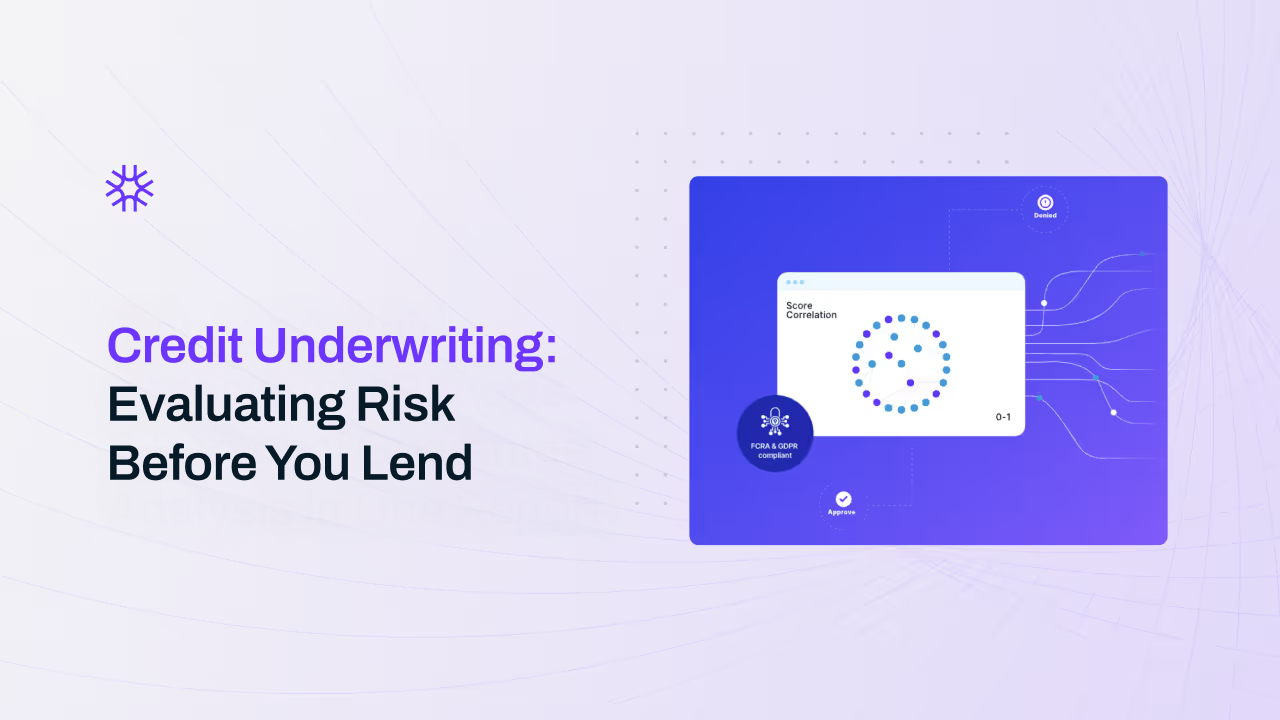
Underwrite.ai's models are fully compliant with FCRA and GDPR. They maintain complete explainability, documenting which factors influenced each decision. Their disparate impact analysis tools help identify potential fair lending issues before deployment.
Speed and Automation in Credit Underwriting
Manual credit underwriting takes time. An underwriter reviews the application, examines documentation, pulls credit reports, and makes a judgment. This might take hours per application.
Automated underwriting completes in seconds. The system pulls data from multiple sources, applies the credit model, and returns a decision. Only exceptions requiring human judgment get routed to manual review.
Speed matters competitively. Borrowers shopping for credit often accept the first approval they receive. A lender that decides in seconds wins business that a lender taking days would lose.
Underwrite.ai delivers credit decisions in under half a millisecond. A UK auto lender reduced decision time from 2-3 days to milliseconds while maintaining prediction accuracy above 98%.
Getting Started
Effective credit underwriting requires historical data. The model needs examples of loans that performed and loans that defaulted, linked to the information available at application time. More data spanning varied economic conditions produces better models.
Custom models trained on your specific lending data outperform generic industry models. Your borrower population differs from other lenders. Your risk appetite differs. A model calibrated to your portfolio will align better with your business.
Underwrite.ai builds custom models using each client's anonymized data. They handle model development and maintenance. The 30-day free trial lets lenders test performance against their actual applications before committing.
Related topics:
- Credit Risk Modeling: Building predictive models
- AI Underwriting: Machine learning in credit decisions
- Automated Underwriting Systems: Automation in loan processing
- Credit Analysis: Detailed borrower assessment
- Lending Underwriting: The underwriting process
Learn more about Underwrite.ai or start a free 30-day trial.