AI Underwriting: What It Does and How It Works
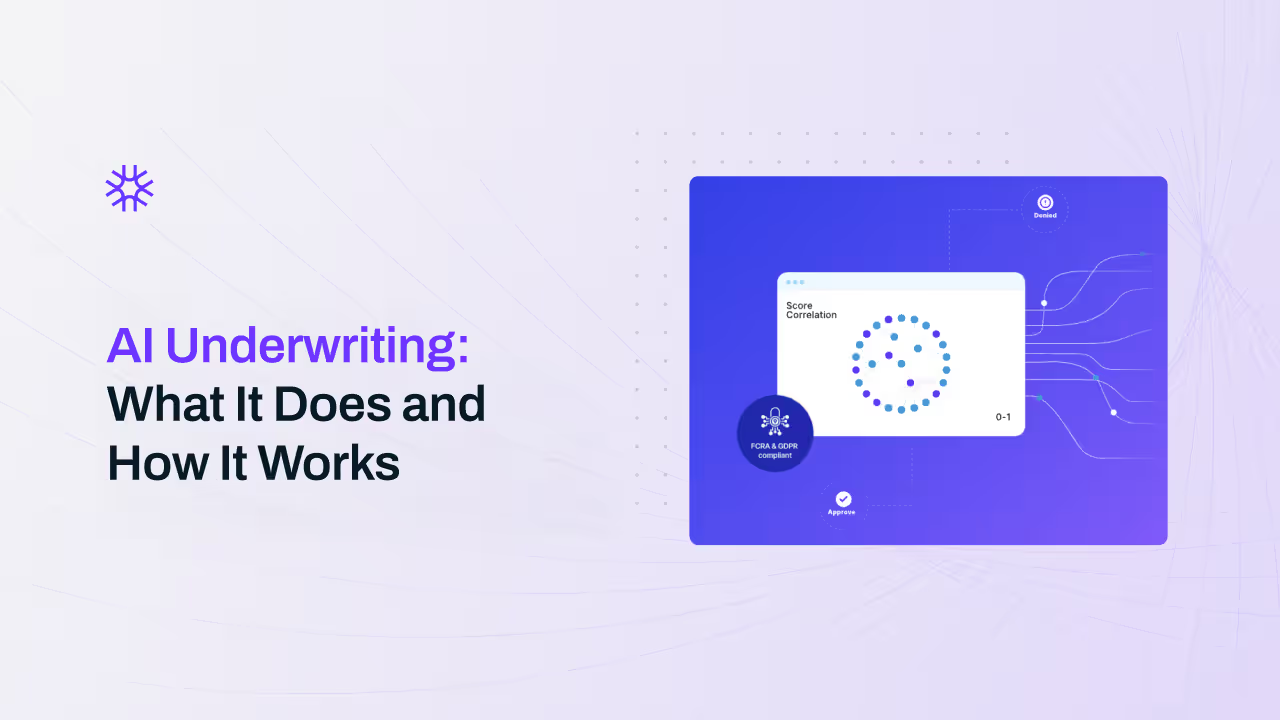
AI underwriting uses machine learning to evaluate loan applications. Sometimes called AI-based underwriting, this approach replaces limited, predefined rules with systems that learn patterns from historical lending data. They analyze more variables, find nonlinear relationships, and often make better predictions than traditional scorecards.
How AI Underwriting Differs from Traditional Scoring
Traditional credit scoring uses logistic regression models with a handful of variables. FICOTM scores, for example, are based on five categories: payment history, amounts owed, length of credit history, new credit, and credit mix. These categories combine into a single number between 300 and 850.
This approach works reasonably well. It's been the industry standard for decades. But it has limitations.
Logistic regression assumes linear relationships. It can't easily capture interactions between variables or threshold effects. It uses only the variables humans chose to include. And it requires a human analyst to identify and encode any nonlinear patterns.
Machine learning models work differently. Given enough historical data, they find patterns automatically. A gradient boosting model might discover that borrowers who opened three or more credit cards in the past six months while also increasing their credit utilization above 80% default at unusually high rates. No human programmed that rule. The algorithm found it.
What Machine Learning Adds
Machine learning brings three capabilities traditional scoring lacks.
First, it processes more variables. Traditional scorecards might use 15-20 factors. Machine learning models can analyze hundreds. More data points mean more information about each borrower.
Second, it finds nonlinear relationships. The connection between debt-to-income ratio and default risk isn't a straight line. Default probability might be flat below 35% DTI, then increase sharply above 40%. Machine learning models capture these threshold effects automatically.
Third, it discovers interactions. Variables that seem unimportant individually might be highly predictive in combination. High credit utilization plus recent inquiries plus short credit history might signal risk that none of those factors would indicate alone. Machine learning finds these combinations without being told to look for them.
Performance in Practice
Underwrite.ai began working with an online installment lender whose first payment default rate was 32.8%. Overall defaults exceeded 60%. By implementing a machine learning model as their sole underwriting methodology, the default rate for the first three payments dropped to 8.5%.
In a study of the Korean credit market, Underwrite.ai compared a highly efficient logistic regression model against a gradient boosting approach. The logistic regression, already well-tuned with carefully selected variables, achieved an AUC of 0.906. The machine learning model achieved 0.958.
These aren't outlier results. Machine learning consistently outperforms traditional scoring when trained on sufficient historical data. The gains come from capturing patterns that linear models miss.
The Explainability Requirement
Regulators require lenders to explain credit decisions. When an application is declined, the borrower has a right to know why. This creates a challenge for AI underwriting.
Some machine learning models are difficult to interpret. A neural network with multiple hidden layers produces accurate predictions but can't easily articulate which factors drove a specific decision. These "black box" models create compliance problems.
Explainable AI addresses this. Techniques like SHAP (SHapley Additive exPlanations) decompose predictions into contributions from individual variables. For any given application, the system can report: credit utilization contributed +0.08 to predicted default probability, recent inquiries contributed +0.05, length of credit history contributed -0.03.
Underwrite.ai's models maintain full explainability. Every decision includes documentation of which factors influenced the outcome. This satisfies regulatory requirements while preserving the predictive power of nonlinear algorithms.
Fair Lending Compliance
Fair lending laws prohibit discrimination based on protected characteristics. Race, gender, national origin, religion, and similar factors cannot influence credit decisions.
Machine learning creates subtle compliance risks. A model might not explicitly use race as a variable, but if it uses zip code, and zip codes correlate with race due to historical housing segregation, the model could produce discriminatory outcomes indirectly.
Disparate impact testing checks for this. The analysis compares approval rates and other outcomes across demographic groups. If protected groups receive systematically different treatment after controlling for legitimate credit factors, the model may have compliance problems.
Underwrite.ai provides disparate impact analysis tools. Their models are designed to avoid using data that proxies for protected classes. The platform generates reports showing whether outcomes differ across demographic groups, allowing lenders to identify and address potential bias before deployment.
Data Sources
Credit bureau data provides the foundation for most AI underwriting. Payment histories, existing debts, credit inquiries, account ages, and utilization patterns all contribute to default prediction.
Alternative data expands what models can evaluate. Bank transaction records show actual cash flows. Utility and rent payment histories reveal payment behavior not captured by credit bureaus. Employment verification confirms income stability.
These alternative sources help with thin-file borrowers who lack extensive credit histories. Traditional scoring struggles with these applicants because the data simply isn't there. AI underwriting can incorporate non-traditional signals to assess creditworthiness.
Underwrite.ai has successfully modeled credit risk for populations with limited or no credit bureau data, including unbanked borrowers in rural Mexico and less developed provinces of the Philippines. The nonlinear approach works even when traditional data is sparse.
Speed and Automation
Traditional underwriting often requires human review. An underwriter examines the application, pulls credit reports, verifies income, and makes a judgment call. This takes time and costs money.
AI underwriting automates routine decisions. The model evaluates the application, checks it against lending criteria, and returns a decision in milliseconds. A UK auto lender working with Underwrite.ai reduced decision time from 2-3 days to 2-3 milliseconds while maintaining prediction accuracy above 98%.
Speed matters for customer acquisition. Borrowers shopping for loans often accept the first approval they receive. A multi-day delay means lost business to faster competitors.
Automation also reduces costs. Staff that previously reviewed routine applications can focus on exceptions that genuinely require human judgment. Volume scales without proportional headcount increases.
When AI Underwriting Makes Sense
AI underwriting delivers the most value when:
Volume is high. The fixed costs of model development spread across many decisions. A lender processing thousands of applications monthly gets more leverage than one processing dozens.
Historical data exists. Machine learning requires examples to learn from. Lenders with years of performance data can train accurate models. New lenders without track records may need to start with industry-standard approaches.
Traditional scoring leaves room to improve. If current methods already achieve excellent separation between good and bad borrowers, machine learning may add little. The biggest gains come when existing models underperform.
Speed matters competitively. Markets where response time influences customer choice benefit most from automation. Consumer lending and auto financing fit this profile.
Implementation Considerations
Deploying AI underwriting requires clean historical data. The model needs application records linked to loan outcomes. Incomplete data, inconsistent definitions, or missing variables limit what the model can learn.
Integration with existing systems requires planning. The AI model must connect to your loan origination platform, pull data from credit bureaus and verification services, and return decisions in a format downstream systems can process.
Ongoing monitoring ensures the model stays accurate. Borrower behavior changes over time. Economic conditions shift. Regular validation checks whether predictions still match actual outcomes.
Underwrite.ai handles model development and maintenance. Clients provide anonymized loan and application data. Underwrite.ai builds a custom model calibrated to that specific portfolio and lending environment. The 30-day free trial lets lenders test performance before committing.
Related topics:
- Credit Risk Modeling: Building predictive models
- Automated Underwriting Systems: Automation in loan processing
- Credit Analysis: Evaluating borrower creditworthiness
- Lending Underwriting: The underwriting process
Learn more about Underwrite.ai or start a free 30-day trial.