How Automated Underwriting Systems Work
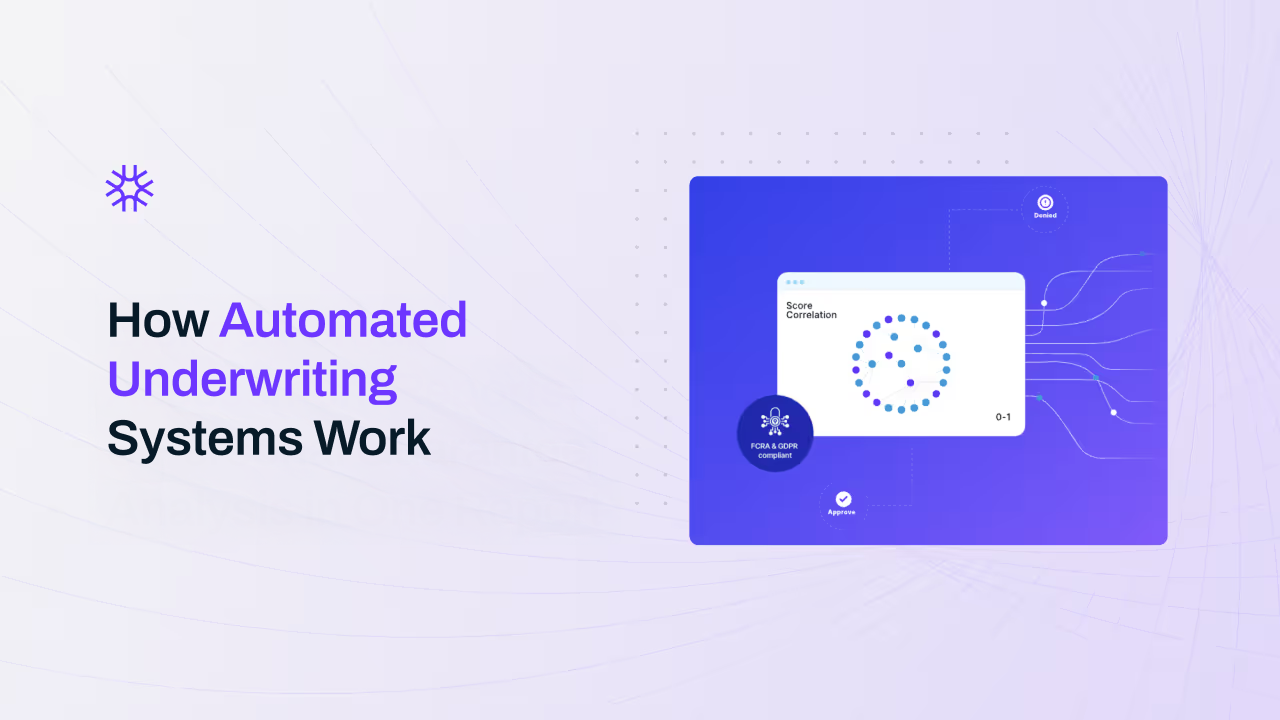
Automated underwriting uses algorithms and machine learning to evaluate loan applications. Instead of manual review, these systems analyze data from credit bureaus, verify income, check debt-to-income ratios, and calculate default probability in seconds.
What These Systems Actually Do
When an application comes in, an automated system:
- Pulls credit bureau data
- Verifies income and employment
- Calculates debt-to-income ratio
- Checks the application against lending criteria
- Returns a decision: approve, decline, or refer to human review
The output typically falls into those three buckets. Straightforward applications get automatic decisions. Borderline cases get flagged for an underwriter to review manually. This lets experienced staff focus on situations where human judgment matters most.
Rules Engines vs. Machine Learning
Basic automated systems use rules engines. These encode lending policies as if-then statements: if credit score is above 680 and DTI is below 36%, approve. Rules engines are transparent and easy to modify, but they can only evaluate factors you explicitly program.
Machine learning systems work differently. They analyze historical loan data to find patterns that predict default. A gradient boosting model might discover that borrowers who round their stated income to the nearest $5,000 default more often than those who report exact figures. No human programmed that rule. The algorithm found it in the data.
Machine learning models can identify subtle patterns and non linear relationships that rules engines miss, but they require good historical data to train on. Without enough examples of both performing and defaulting loans, the model has nothing to learn from.
Why Accuracy Matters
Consider two underwriting models. Model A has an AUC (area under the ROC curve) of 0.90. Model B has an AUC of 0.95. That gap sounds small, but it translates to real money.
Higher accuracy means approving more good borrowers while rejecting more bad ones. A lender using Model B can safely approve applications Model A would decline, expanding their customer base without increasing defaults. They can also catch risky applications that Model A would approve, reducing losses.
In a Korean credit market study, Underwrite.ai demonstrated this difference. Their nonlinear model achieved an AUC of 0.958 compared to 0.906 for a highly efficient logistic regression model. Both models used credit bureau data. The difference was in how they processed it.
The Data Problem
Most automated systems rely heavily on credit bureau data. This works well for borrowers with established credit histories. For thin-file borrowers with limited credit history, the data simply isn't there.
Alternative data sources help address this gap. Bank transaction patterns, utility payment records, and rental history provide signals about creditworthiness that don't appear on credit reports. Incorporating these sources lets automated systems evaluate borrowers traditional scoring methods overlook.
Underwrite.ai began working with an online installment lender whose first payment default rate was 32.8%. By incorporating broader data sources into a nonlinear model, they reduced that rate to 8.5% for the first three payments.
Speed and Cost
A UK auto lender faced an interesting problem. Their human underwriting was accurate, with low charge-off rates, but the process took 2-3 days. Underwrite.ai built a model that matched the accuracy of their human underwriters but returned decisions in 2-3 milliseconds.
That speed difference matters for customer acquisition. Borrowers shopping for auto loans often take the first approval they receive. A 2-3 day wait means lost business to faster competitors.
Processing costs also drop significantly. Staff that previously handled routine applications can focus on exceptions and relationship management. Volume scales without proportional headcount increases.
Compliance Requirements
Automated underwriting must satisfy fair lending requirements. The Equal Credit Opportunity Act and Fair Housing Act prohibit discrimination based on protected characteristics. Models cannot use race, gender, national origin, or similar factors in credit decisions.
This creates a challenge for machine learning. If a model considers zip code, and zip codes correlate with race due to historical housing segregation, the model could produce discriminatory outcomes without explicitly using race as a variable. Disparate impact testing examines whether protected groups receive different treatment even when models don't directly consider protected characteristics.
Consistency is another extremely important factor. Unlike Generative AI and LLMs, the rigorous statistical models used in lending must be idempotent, meaning the decision to approve or deny a loan must always be fully repeatable and consistent.
Explainability also matters for compliance. Regulators expect lenders to explain why specific applications were declined. Black box models that return a score without explanation create audit problems. Modern automated systems generate documentation showing which factors influenced each decision.
Underwrite.ai's models maintain full explainability while using nonlinear algorithms. Their disparate impact analysis tools help lenders identify potential bias before it becomes a compliance issue.
Small Business Lending Challenges
Consumer lending and small business lending require different approaches. Consumer underwriting focuses on individual creditworthiness. SMB lending must evaluate both the business and its owners.
A restaurant loan application involves analyzing the company's financials, cash flow projections, and industry risk alongside the personal credit of guarantors. These dimensions interact. A strong personal guarantor might offset weak business financials. Strong business performance might compensate for thin personal credit history.
Blended assessment that considers both dimensions in a single analysis produces better predictions than evaluating business and personal factors separately. Underwrite.ai's SMB product provides this integrated approach, generating a combined risk picture rather than disconnected business and personal scores.
Implementation Considerations
Deploying automated underwriting requires clean historical data. The model needs examples of loans that performed and loans that defaulted, along with the application data that existed at origination. Incomplete or inconsistent data limits what the model can learn.
Integration with existing systems also requires planning. The automated system needs to connect with your loan origination platform, pull data from credit bureaus and verification services, and return decisions in a format your downstream systems can process.
Custom models trained on your specific lending data will outperform generic models trained on industry-wide datasets. Your borrower population differs from other lenders. Your risk tolerance differs. A model trained on your loans and calibrated to your policies will align better with your actual business.
Underwrite.ai builds custom models using each client's anonymized loan and application data. We offer a free 30-day trial period to test the model against real applications before committing.
What Automation Cannot Replace
Automated underwriting handles routine decisions efficiently. It does not replace human judgment for complex situations.
A borrower with unusual income sources, a business with nonstandard financials, or an application with conflicting information may need human review. The automated system can flag these cases and provide supporting analysis, but the final decision benefits from an experienced underwriter's assessment.
The goal is appropriate allocation of human attention. Let machines handle the applications where the answer is obvious. Let humans focus on the cases where their expertise adds value.
Related topics:
- Credit Risk Modeling: Building predictive models
- AI Underwriting: Machine learning in credit decisions
- Credit Analysis: Borrower assessment methods
- Lending Underwriting: Modern underwriting practices
Learn more about Underwrite.ai or start a free 30-day trial.